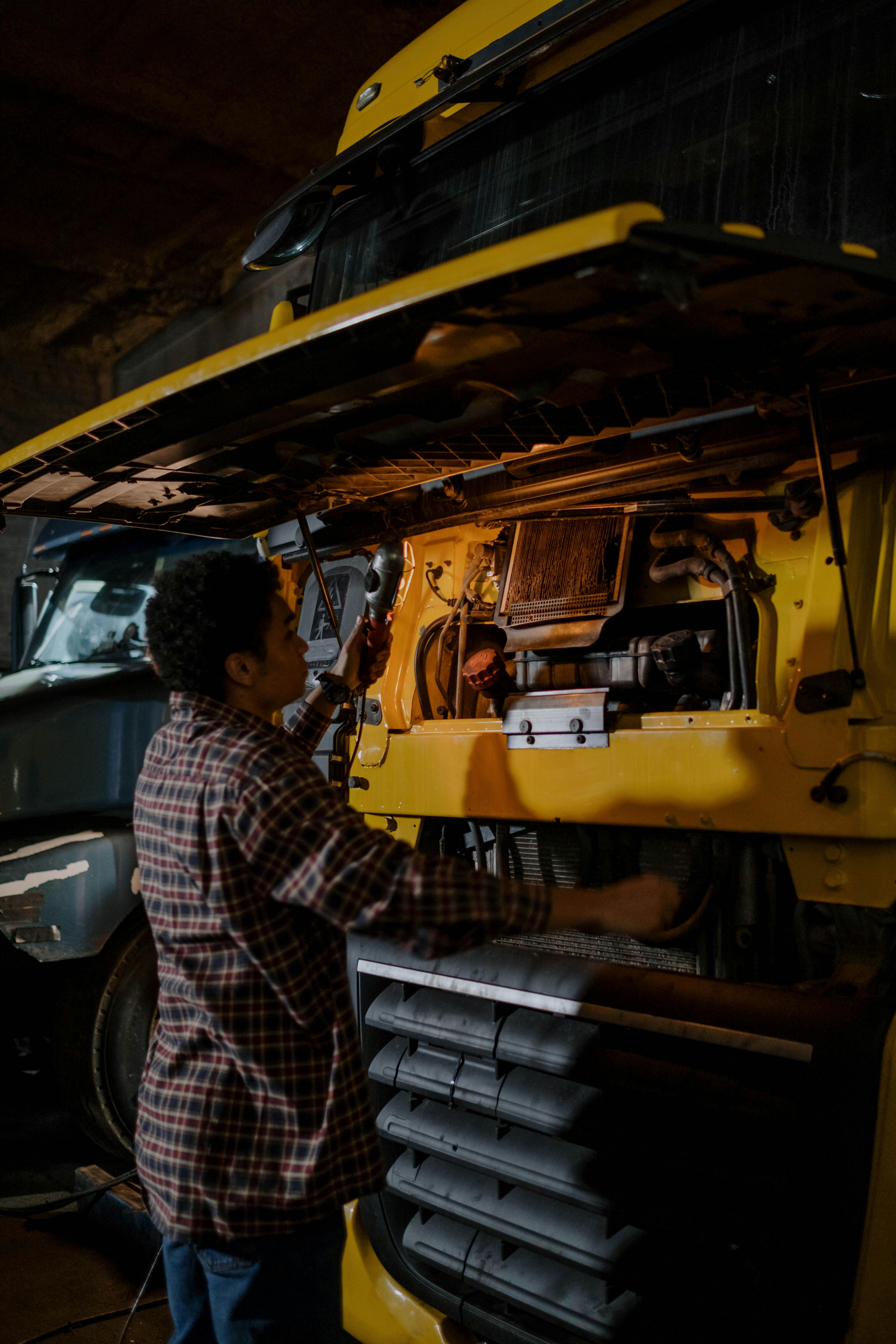
Fleet technician working under the raised hood of a heavy truck
Trucking & logistics

Every tractor.
Every shift.
Roadready.

A terminal shop runs on knowledge. The foreman who knows tractor 47 pulls left on a long descent, the tech who knows the shortcut on a Freightliner fuel system, the parts man who knows which cross-reference actually fits. When that knowledge is in the system, technicians can use it on any shift.

THE TERMINAL SHOP

The rhythm of a shop
that keeps trucks moving.

A carrier's maintenance operation has a cadence. Peak season, roadside inspection cycles, end-of-quarter pushes. Shops that handle those periods well make the information available to the whole team instead of leaving it with one person.

Peak season

Every tractor has to roll.

During peak, you don't have the luxury of a unit sitting while someone tracks down the right answer. The shops that keep throughput up when it matters most are the ones where every tech on every shift can find what they need without hunting someone down. The information needs to be available to the technician doing the work, not only to the person who remembers it.

DOT inspections

Ready before the examiner arrives.

Roadside inspection season has its own rhythm. The foreman who knows which tractors have borderline brake lining, which lights have been written up before, which units are due for a walk-around before they hit the road. When that knowledge is in YardWise, the technician preparing the unit can use it without having to find the foreman.

Overnight shifts

The night crew needs the same answers.

The best diagnostic knowledge in your shop doesn't do much if it only lives in the heads of the day shift seniors. The tech pulling an overnight on a tractor that came in with a recurring fault deserves the same starting point as someone who's seen it a dozen times. Yardwise makes sure they get it.

WHAT SETS THEM APART

What the best
terminal shops have figured out.

The shops that keep their fleets moving usually have the basics under control. They also make those basics accessible to the whole crew, rather than leaving the hard won knowledge with a few veterans.

First-time fix

The right diagnosis
before the unit goes back up.

A tractor that comes in for one fault and leaves with an unresolved secondary issue costs more than it should. The shops with the best first-time fix rates aren't necessarily staffed with better mechanics. They're staffed with mechanics who have access to what the shop already knows about that unit, that fault, that model year. Yardwise makes that access consistent.

Tractor-specific knowledge

What the fleet knows
about each unit.

The foreman who knows tractor 47 by number knows it because they've worked on it. That unit-level knowledge, the recurring fault, the route condition that affects wear, the previous repair that matters for the next one, belongs in the record. When it's in Yardwise, any tech pulling that unit has the same context the foreman has.

Succession

What happens when
the foreman retires.

The foreman who knows every tractor by number is also, in many carriers, within five years of retirement. The question isn't whether they'll leave. It's whether the knowledge leaves with them. Yardwise captures it before that happens, in the normal course of work, without asking anyone to sit down and write a manual.

HOW YARDWISE FITS

Next to what
you already run.

Most carriers already run a maintenance management system for work orders and PMs. Yardwise doesn't replace that. It adds the knowledge layer that tells your techs what to do and why, drawing from your OEM documentation and what your own shop has figured out.

Your work order system tracks what happened. Yardwise handles the moment before the work order gets written, when the tech is standing in front of the unit trying to figure out what's actually wrong and what the right fix is. Those are different problems and they need different tools.

We load your OEM documentation for the makes and models you run. Freightliner, Kenworth, Peterbilt, International, Volvo, Mack. Whatever your fleet runs, the service manuals go in. Your techs search by symptom, system, or procedure and get the relevant section with the page number cited.

On top of the OEM documentation, your seniors add the carrier-specific knowledge. The overrides for your routes, the parts that work and the ones that don't on your specific spec, the recurring faults on your model years. That goes in by voice, in two minutes, and comes back cited in every answer related to that unit or fault type.

The aim is to make experienced technicians' knowledge available on every shift without replacing the systems the shop already uses.
TALK TO US

Tell us what your fleet runs and we can show you how it would work there.

A thirty minute call about your terminal, your fleet makeup, and where the knowledge gaps are today. Pilots run around one terminal or one equipment line. You see it working before any contract.

A pilot scoped
to your terminal.

We come in with your OEM manuals loaded. Your foreman adds the first knowledge entries. Two weeks in, every tech on every shift has the same starting point on each unit. You decide from there.

Book a call Stronger shop team
Makes supported Freightliner, Kenworth, Peterbilt, International, Volvo, Mack, others
Pilot setup Two weeks, one terminal
First call 30 minutes
Also fits next to Works alongside Fleetio, RTA, FASTER, Dossier